
MMP-LMHS Development Story (not used)
Superconductors
Energy In Society
Energy
Energy is a requirement for growth. As nature includes mechanisms that actively increase entropy, energy is most often a required input just maintain status quo. Our civilization has been shaped by the development of methods to extract energy from increasingly convenient and potent sources.
Currently, there is no more convenient method for the transmission and usage of energy than electricity. With increasing regularity most energy under human control will be converted into an electrical form for widespread usage. Consequently, technology that increases the efficiency of conversion, transmission, or application of energy will be beneficial to societal goals. There is a technology that has been demonstrated in laboratories for more than 100 years and excluding select use has yet to become widespread incorporated into society. Discovered in 1911, superconductivity holds the potential to introduce significant increases in efficiency and power density in electrical systems.
What Are Superconductors?
Energy → Superconductivity
Superconductors (SC) are materials that have the ability to conduct electricity without loss. These electrical conducting materials do not obey Kirchhoff’s laws of [Voltage = Current x Resistance]. The reason being an SC has no electrical resistance or on a materials level there is no drift velocity effect from the material lattice on the electrons to impede a moving current. A theoretical reason for such perfect conductance comes from electrons or other fermions travel through an SC by distorting the material lattice with what is known as a Cooper pair. The only resistive elements in an SC in the SC state are splices between SCs or connections to the SC. The net effect is still many orders of magnitude less resistance and hence a negligible current drop for an SC over a classical conductor.
The primary difficulty with SCs is that to date they only operate at very low, cryogenic, temperatures. A further known relationship is the higher the power or energy application, the lower the temperature operational requirement. On a microscopic scale this is due to the weak Cooper pairing force where a minimal amount of thermal agitation exceeding the low electron volts (eV) pairing energy will break the Cooper pair. On a macroscopic scale this temperature dependence leads to an SCs falling out of superconducting mode when they leave what is called the corner point bounded by what is known as the SC’s critical temperature, magnetic flux density, and current density as depicted in Figure 1. These interrelated values represent the temperature, magnetic, and current values that an SC must remain within else the SC phase of the material is lost. Therefore the SC must operate below these critical values at all times.
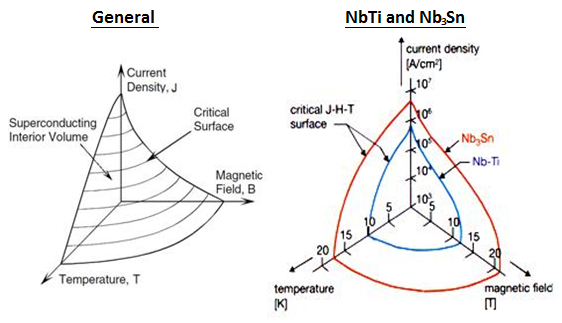
Figure 1: Superconductor Critical Value Corner Points
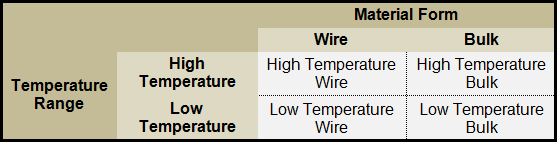
Further discussion of the critical values requires the introduction of superconductor classifications by material form and characteristic temperature. In the application world there are 4 overlapping classifications for SCs as listed in Table 1.
Table 1: Superconducting Material Classifications
Of the three critical values, only SC temperature is externally controlled. Conversely, the magnetic field and current density are both controlled to some degree from the initial SC material fabrication through to operation of each SC type. The current density is controllable for a wire type SC but not a bulk type SC where current vortices surrounding flux pinning centers are an artifact of the material. The magnetic flux density is only controllable when discussing an external magnetic field applied whereas the self magnetic flux density is also an artifact of the current density within the SC and once generated it can only be controlled through surrounding material and geometric choices once leaving the SC.
Another method of SC classification is according to base superconducting phenomena. SCs are either Type I or Type II. For energy and power system applications, Type II SCs are relevant.
Why Superconductors?
When considering a product, SCs bring a higher complexity and initial cost than non-SC conventional solutions that have stood the test of time. So why make the SC leap?
Engineers make a living through the term, , efficiency. Otherwise, all engineers would be physicists. Engineers across all disciplines struggle to attain increased power efficiency and in particular within a decreased mass and volume, or power density.
Resulting from zero electrical resistance, SCs provide potential for exceedingly high efficiencies and power densities compared to any non-SC conventional option. This high efficiency and/or power density prospect is the primary driver for any SC application. SCs allow the highest amount of controlled macro scale power dense electromagnetic current transfer known to humankind to date. The resistive power loss which turns electrical current into heat is a great concern from small computers to large energy and power systems. In the latter case, power transmission requires a high current density to assist the transfer of electrical inertial energy and preferably low magnetic fields to remove latencies in the form of reactance values but more importantly to remove any additional losses from the motion of flux pinning centers and added induced current loss effects. Certainly the electromagnetic effect involves a combined electrical and magnetic field, but the Type II SC material can be produced to increase or decrease the number and types of flux pinning centers which in turn assists with holding more magnetic flux at a certain location to increase the magnetic field or decrease the flux pinning centers and thereby increasing the current density possible. In the energy systems case of a motor or generator type machine, this machine type is only a dynamic electromechanical transformer with a magnetic link between the mechanical and electrical sides. Such a machine requires a high magnetic field linkage in the air gap.
Why Superconductors Now?
SCs offer the potential for an application revolution in energy systems, the transformation or storage of energy, and power systems, the motion of energy. Focusing on energy systems for rotating machines, these machines can become extremely power dense due to a high rotational velocity or the increased magnetic flux density capabilities an SC provides over conventional wire wound machines or even permanent magnet based machines. A power density increase via a rotational velocity increase is well suited for a medium to small machine size where gyroscopic motion and other velocity related effects are not a concern. A power density increase via a SC machine plant operates fundamentally by increasing the primary to secondary coupled magnetic flux density which for a motor translates to a torque increase and for a generator to an emf increase. In the machines industry alone there has only been incremental advancement for over a century within the plant part of the system. The advent of large scale SC machines would be the first revolution in this industry since its birth in the late 1800s. Minor revolutions did occur while developing our basic machine types in the late 1800s to early 1900s but otherwise this industry has been mostly static from the plant side. In the late 1980s and 1990s another minor revolution occurred on the machine control side due to ancillary developments stemming from semiconductor switching technologies for higher voltage and current combined with computers for low level Pulse Width Modulation (PWM) controllability to medium level vector control.
This can all now change with the first major machine plant advancement in a century. Thanks to the cost and reliability of another ancillary technology in the past decade, cryogenics becoming more robust and affordable even down to low cryogenic temperatures, SCs are finally becoming an application reality. Due to the loss of SC if there is a cryogen loss, then cryogenic equipment is still vital and must advance, yet proper reliability through redundancy techniques of both the cryogen circuit and supporting vacuum jacket can solve most of today’s application issues.
SC materials have cleared the technical performance hurdles when maintained at low temperatures some time back, many costs have finally lowered to marketable levels, and many past ancillary cryogenic concerns are solved. Among SC form classifications presented in Table 1, technical performance of bulk SCs is subject to some remaining challenges however wire SCs perform very well in the lab and in small quantities have been wound and operated in single custom device operations.
Led by the proven performance of wire SCs, supported by recent improvements in required cryogenic systems, and motivated by an expanding need for energy, the SC industry is finally ready to embark upon a new technological revolution. Design and support businesses must prepare for the technical application of SCs through to commercial production.
Superconducting Application Problems
What Is Missing?
Energy → Superconductivity → Technical Reliability
Potential rewards offered by the incorporation of SCs into products provide significant motivation to develop applications. The primary reason SCs are not regularly specified by application engineers is that technical reliability is absent from the initial device creation to follow on support needs. Without a focus on SC technical reliability then the new age of the SC wire industry, above liquid helium cryogenic levels, will remain in the materials lab and the many awaiting SC device applications will not enter the commercial world.
Bulk SCs, or trapped field magnets (TFMs), have the added problem of solving the very difficult activation and deactivation technical application hurdles before allowing the move from the materials lab into a final energy systems device application. TFMs perform well in the lab but have not entered a single application due to this added problem.
Although research is underway to create SC applications with collections of discrete bulk shapes, the fundamental shape of the linear conductor offers more versatility in energy conversion and transmission applications. Wire SCs actually perform very well in the lab and in small quantities have been wound and operated in single custom device operations, but they still lack technical reliability. Technical reliability allows turning the final device manufacturing process into a quality controlled and assured process that can be trusted to repeatedly perform in the final application device. When technical reliability combines with automation and versatility then both the final system cost lowers and the variety of output types increases. Without a technically reliable system no commercial application is achievable due to a greatly increased failure rate and unpredictable failure events.
Technically reliable SCs galvanize the first machine revolution in over a century. SC wire manufacturing needs span both low and high temperatures SCs (LTS & HTS). The most prominent high performance SC linear materials are MgB2 and Nb3Sn LTS wires and YBCO and BSCCO HTS tapes where each are extremely delicate and require an appropriate system for automation and technical reliability. In the LTS case one also desires handling reacted wire to remove reaction process concerns such as compromised insulation and extremely large thermal masses to support the high heat treatment.
Examples of SC Applications Awaiting the SC Revolution
Wind Turbines
In the private sector, a great example of an SC opportunity is an onshore or even more significant an offshore wind turbine where the volume and weight allowable for any wind turbine is extremely limited by what can be suspended up a tower. Conventional wire wound induction wind generators may be able to achieve ~3.5MW ratings. Permanent magnet wind generators are limited to ~4.5MW ratings. SC wind turbines readily achieve 10MW offshore, as many current global initiatives require, and SC applications in Europe are even discussing 20MW SC wind turbines as recent as 2010.
Power utilities are willing to pay a premium for higher power offshore wind turbines since each part of a percent saved in power efficiency translates to extreme financial earnings over time. Via distributing the power generation across more wind turbines, all of the losses starting with power transmission are much greater than a single unit. This provides motivation to develop SC wind turbines but only if these wind turbines are reliable. The downtime for any wind turbine is an extreme financial burden. This extreme service cost is often so prohibitively expensive that wind farm operators frequently take wind turbines offline instead of servicing only a few at a time.
MRI
The Magnetic Resonance Imaging (MRI) industry, the only industrial SC application at a currently estimated $5.5B global industry and growing, relies upon the extremely low temperature requirements of SC wire at liquid helium temperatures, 4.2K. Although technical reliability is not as critical a concern with this particular SC wire type, albeit an automated technically reliable solution will certainly assist this current SC choice, the need for an MRI machine outweighed all other costs. Yet, even in the MRI industry, the objective is to replace all extremely low temperature MRI units with a higher temperature SC solution. The primary hold on this transition is again a technically reliable final machine.
Military Applications
The ultimate competition of humankind challenges societies’ scientists and engineers to produce technically superior systems. High-energy storage and high power output is often required in a very small package. This is particularly true as the U.S. armed forces continue their aim towards fewer personnel to perform a task through all electric systems. The entire U.S. armed forces, from the USAF extremely power dense and high speed generators for the all electric aircraft to the U.S. Navy all electric fleet to the U.S. Army modern armored battalions and deployable power support, all desire and in some require to enter into this SC revolution. The manufacturing of all such developing SC devices must not only provide an initial SC high power dense application design but also logistically control this specialized supply chain support need else this SC revolution will be suppressed by cost and schedule.
U.S. Navy ships for the all electric fleet experience the same technical reliability hesitation as commercial industry. A machine operating the ship propulsion and/or entire ship services power generation must be reliable. Losing power at sea can be crippling to disastrous in calm to high sea state conditions for the vessel. Yet the electric destroyer development for the U.S. Navy requires high power dense machines from ship propulsion and services to the extreme power requirements for the modern fleet high energy radars and weapon systems such as the line of sight kinetic energy railguns, exoatmospheric railguns, and high energy lasers. Losing propulsive, weapons systems, and U.S. Navy coined operational fight through power while in combat can endanger not only the vessel but also the mission which could be catastrophic on a scale much greater than the ship itself. A specific U.S. Navy example is the Zumwalt class DDG-1000 next generation destroyer propulsion system rated at 36.5MW, 6.6kV, and 120rpm capable competition where for this set power and speed rating a significant difference across three considered motor topologies was mass and volume. The propulsion power plant chosen and presently planned for deployment is the Converteam team’s based advanced induction motor concept. The DRS team proposed permanent magnet motor built and tested was reportedly around 80% of the induction machine’s mass and volume whereas the AMSC team built and tested proposed SC wire motor was reportedly 47% volume and ~30% mass of the induction machine while providing a higher efficiency. Such a leap in technology is truly revolutionary yet the AMSC team presumably lost with technical reliability of the SC wire being a primary concern.
High Field Test Magnets such as Particle Accelerators
Extreme high magnetic flux density windings include dipole, quadrupole, and higher order multipole corrector magnets for use in particle accelerators, magnetic energy storage rings, and charged particle beam transport systems. One magnetically rigorous example, as identified by global universities and national labs, is accelerator magnets. A particle accelerator loss of SCs during a full power test run can destroy large elements of the multibillion dollar accelerator system. Here not only operational magnetic field uniformity and the use of winding tension techniques to reduce the winding radial stress is crucial but the extremely high magnetic stresses, many resulting from the turn to turn as well overall coil Lorentz forces, require extremely precise and delicately handled coil builds else imperfections lead to premature fatigue.
A recent example is the operational cost of now the second shut down of the $9B+ Large Hadron Collider (LHC) operated by CERN, the European organization for nuclear research. Two shut downs for around one year each, the first caused by a faulty electrical connection to two of the LHC magnets and causing them to quench and physically rip these SCs from their mounts, cost untold $Ms each in repairs and scheduling delays besides delaying the entire mission of the LHC for which the entire global scientific community awaits. There are even concerns that design flaws may not allow this machine, one of the most expensive in history, to ever operate at the designed 14TeV full collision energy capacity.
Summary of Application Examples
Each multibillion dollar application industry listed above is awaiting SC technical reliability to reduce operating costs and increase capabilities. A solution for technical reliability has now been identified.
Infinity Physics Introduces MMP-LMHS
Energy → Superconductivity → Technical Reliability → MMP-LMHS
Technical Reliability Limitations of Past Linear Media Handling Solutions
Conventional winding machines have a long history and sufficed for the majority of the 20th century. Most winding machines offered today require continual manual intervention down to a human interface foot pedal for detail oriented work. Even more constraining, current winding machines rely upon pure mechanical solutions for difficult winding problems. These winding machines are limited to extremely slow manual throughput and no final system quality control (QC) or assurance (QA) which often means a failed winding immediately or via premature operational fatigue. Technical reliability is lost when the SC wire experiences a wire handling stress. One actually hopes this stress point damages the wire to a noticeable degree immediately. Else if the final coil is placed into service then the combined severe mechanical, thermal, magnetic, and electrical cyclic stresses which are unique to an SC coil may fatigue the final coil prematurely and therefore fail the entire machine and hence operational system.
In summary, the products of these tedious methods are prone to inconsistencies that have resulted in low yields and many documented failures.
Significance of Technical Reliability
The Infinity Physics, LLC (InfPhy) team is quite familiar with many commercial, government, and military systems and their associated needs due to decades of past work directly supporting their technical development. Focusing on the SC wire industry due to their high requirements yet no proper solution to date, InfPhy has involvement with industry players from LTS and HTS wire manufacturers to the final component and device users. Poor performance output as accomplished with winding superconductors using conventional winding machines will not be tolerated in industry. A failed winding, which is unfortunately common per today’s standards and practices, can readily cost on the low end from $10Ks and on the high end many $10Ms to $100Ms when in test. This turns into an incalculable figure for a failed military mission when in final operation. InfPhy personnel identified this predicament in the 1990s. It is just recently being recognized more globally by the SC wire manufacturers, SC application end users, and U.S. government entities such as DoE which has historically led this field.
Realizing the significance of the problem, InfPhy developed a solution that provides SC wire technical reliability.
MMP-LMHS
To introduce technical reliability into the development of SC applications, InfPhy developed a Multipurpose Modular Platform – Linear Media Handling System (MMP-LMHS). Capable of winding a wide range of linear media and not limited to only fragile types, this innovation can serve many industries and is particularly targeted for the SC industry. Addressing the most significant and demonstrated remaining concern for the introduction of SCs in commercial applications, LMHS facilitates an industrial revolution. Robust automation for HTS and LTS based final application needs include MRI magnets, wind turbine applications, fault current limiters, superconducting magnetic energy storage rings (SMES), high magnetic energy coils such as particle accelerator magnets, and of course multiple military applications. LMHS also offers existing and future SC machine final product support needs, whether developed through MMP-LMHS or not, for all maintenance, repairs, and spares from technically reliable spare stocks to fast turnaround new builds. The technology required for automation is a properly designed mechanical solution in conjunction with modern closed loop control techniques. Industries such as superconductivity and fiber optics components require large winds with extremely sensitive wire care approaching that of filamentary windings but with automation in mind. Classic winding manufacturers, viewing winding as a separate entity and not as part of an automation process line, refuse to move beyond pure mechanical techniques for delicate issues due to the complexities and high risk involved. In many cases there is a belief that the delicate linear handling required today cannot be automated in any respect. For instance, the strain rate of reacted MgB2 SC alone can be 0.1% for a 6” diameter bend which equates to a minimum bend diameter allowable of 22” with no reverse bends when reacted flat. This is seen as too formidable of a challenge to build a reliable product output nevertheless automate yet this is the LMHS starting point.
In summary, although there are other problems to be solved such as in the cryogenic cooling of rotating and linear machinery, the solution for increasing the technical reliability of forming fragile linear media has addressed a significant cause for the lack of proliferation of applied superconductivity.
Technical Approach
InfPhy responded to a need and over time developed a robust solution. Not only will LMHS solve the high fidelity winding problem but LMHS also focuses on expanding and automating the entire winding process for extremely delicate to any linear media. As for the delicate wire case, a combined exceptional mechanical design working in conjunction with a high precision direct closed loop control solution is required for success. As many wound coils today are too flawed for use, LMHS assists with generating quality winds in a controlled fashion that allows not only a proper starting product, but the Mean Time Before Failure (MTBF) will also greatly increase for deployed SC winds. This capability then allows not only initial application winds but a reliable supply chain of replacements including for the first time the ability to design Line Replaceable Units (LRU) of QA supported SC windings which allow SC swapping without taking the larger machine offline. Not only does the unit cost greatly decrease from the increased application efficiency and performance but the means of stocking SC based replacement parts is so extreme a notion that it’s not been considered in the past due to this lack of SC application technical reliability stemming from the SC winding itself.
Technical Capabilities
LMHS fulfills a minimum of the following top-level objective requirements that have been identified through interactions with industrial needs. Objectives below address primarily machine level technological needs and include elements from machine to operator. The overall need is simple and similar for both an R&D as well as a manufacturing perspective. A modern wire handling solution must be capable of the following and all are designed into the MMP-LMHS.
|
|
Safely handle extremely fragile linear media |
|---|---|
|
|
Repeatable handling of extremely fragile media safely |
|
|
Satisfy QC & QA requirements to achieve higher MTBF |
|
|
Perform all tasks to a production level |
|
|
Provide for large range of media, spool, and final former types |
|
|
Provide for anticipated unknown variables and unique requests and provide multiple stock swap options for the same base machine |
|
|
Media handling requires many combined operations |
|
|
Supply chain support including LRU capability |
.
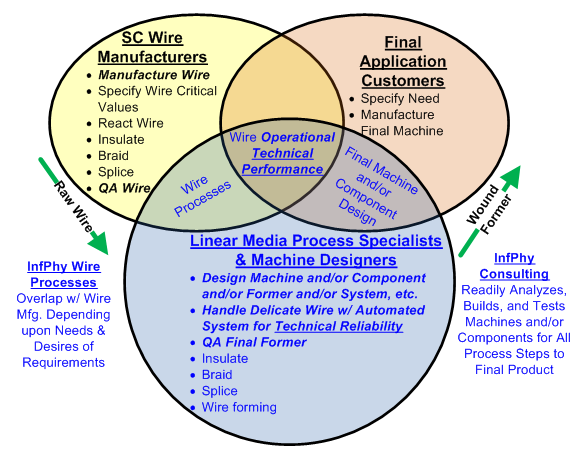
Figure 2: Full Process Solution
As indicated in the bottom region of Figure 2, the innovation achieved by Infinity Physics focuses on far more than creating a wind with inherent technical reliability. LMHS prepares for automation and versatility by designing with the entire system process flow in mind. Therefore LMHS transcends the historic winding machine from a single, isolated process entity into a system providing the foundation of the entire fabrication and assembly line. To consistently control fragile media, such an all encompassing effort provides the best path to achieve physical implementation of linear media handling. LMHS is then used for the initial prototype phase and design phase through to manufacturing while achieving repeatable levels of QC and QA for the first time ever in this industry. Providing the elements necessary for a production line, the necessary supply chain is then finally able to develop for SC applications where QA based components can logistically support a sortie of deployed SC applications.
To achieve automation of winding, Infinity Physics designed sensitive closed loop feedback controls for high precision electric motors affecting both the pay out of media from the spool and also the controlled deposit of media on the former. Axial and off axis tension in the media is precisely controlled and a report of all forces experienced by the media during the wind is compiled. The result is a wind performed much faster than a manual process and supported by quality assurance data.
The range of potential products will bring demands for versatility of the winding procedure. For versatility, the industry standard of dedicated welded steel and cast iron framework for winding machinery was replaced with a framework of aluminum extrusions. Correctly sized, this framework allows easy transformation and expansion of winding procedures including additional operations before, after, and even amidst the media transport from the spool to the former.
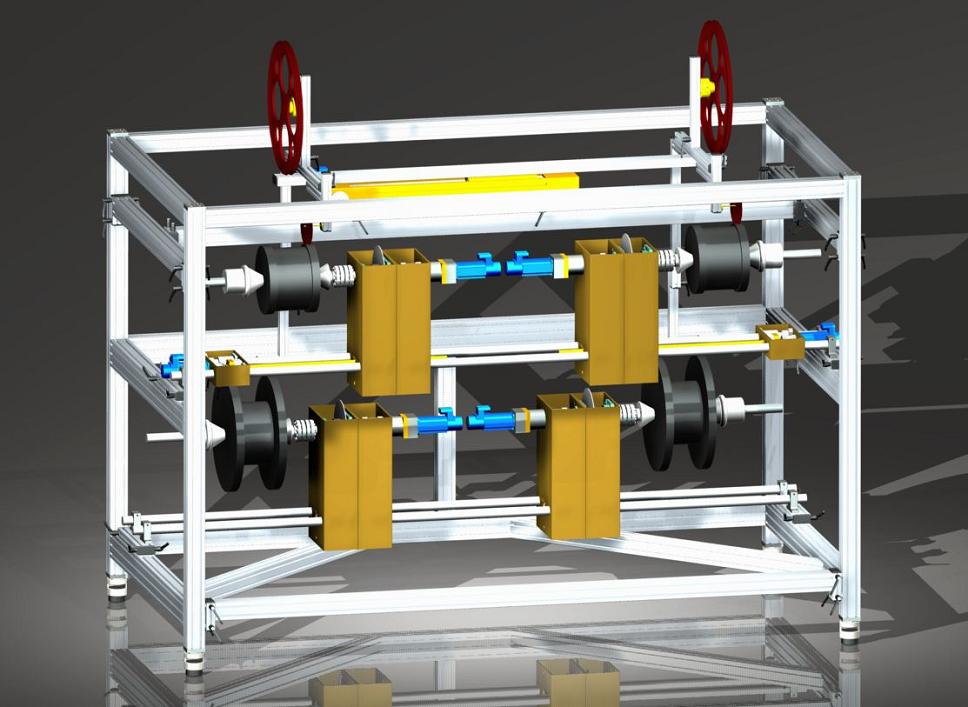
Figure 3: 100 Series Default System
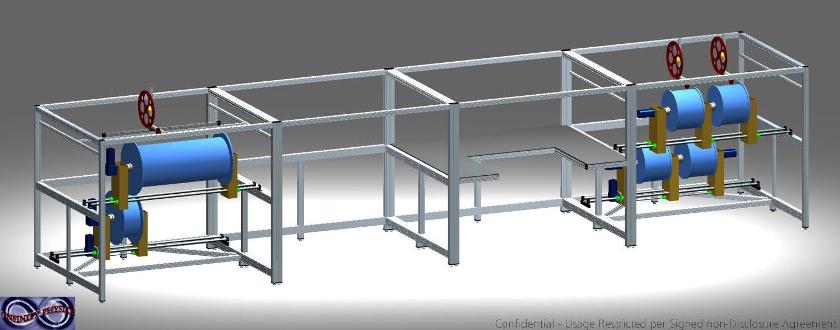
The default configuration chosen for medium sized wind with a maximum diameter in excess of 0.5m diameter and axial lengths of greater than 2m is shown in Figure 3. Shown here, smaller axial lengths accommodate the possibility of dual winds. The default system also features through shaft loading and unloading that can be performed by moving the loads such that they are suspended outside the frame for easy access.
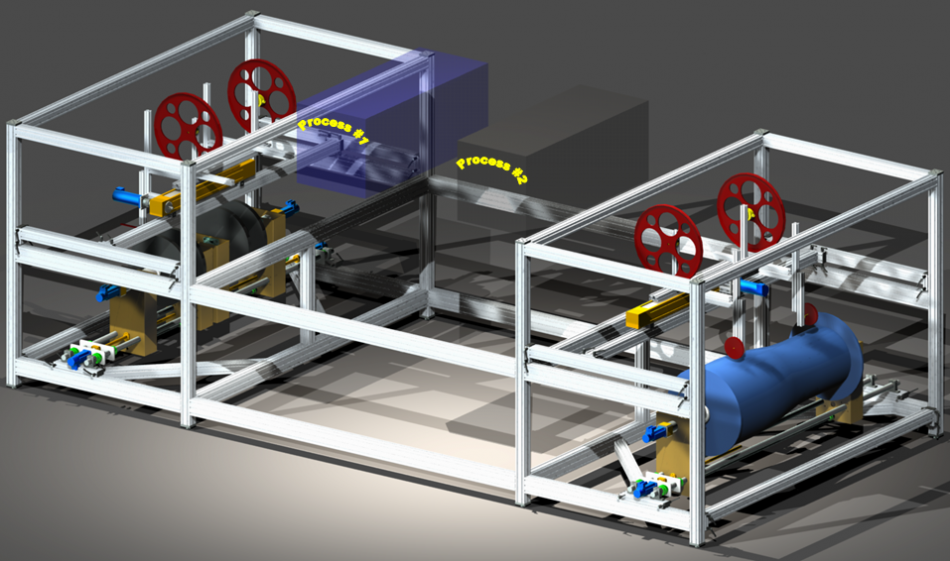
Figure 4: 100 Series Dual Process Solution Example
Figure 4 presents and example configuration where two separate processes of a larger nature are readily provided for a dual wind onto a curved former shape with a simple MMP system and associated control system logic expansion. Such versatility turns an isolated winding process into a complete system solution for the final product coil involving multiple coil processes far beyond winding alone. The aluminum extrusion platform also accommodates customization with established collections of attachments from guards to sensors.
The MMP-LMHS is set into three distinct machine series which overlap to some degree. Series 10 is provides a small linear media handling solution down to the size of component resistors on a printed circuit board. Series 100 is a medium to large linear media handling solution for items such as motor/generator machines and transformers. Series 1000, an example of which is shown in Figure 5, is a large to very large linear media handling solution for items such as motor/generator machines, MRI’s, and large accelerator magnets. Due to the inherent versatility each machine line not only benefits from readily swappable stock options but is readily customizable for any solution.
This well-thought system approach intends to revolutionize the winding industry to support a revolution in the conversion of electrical energy.
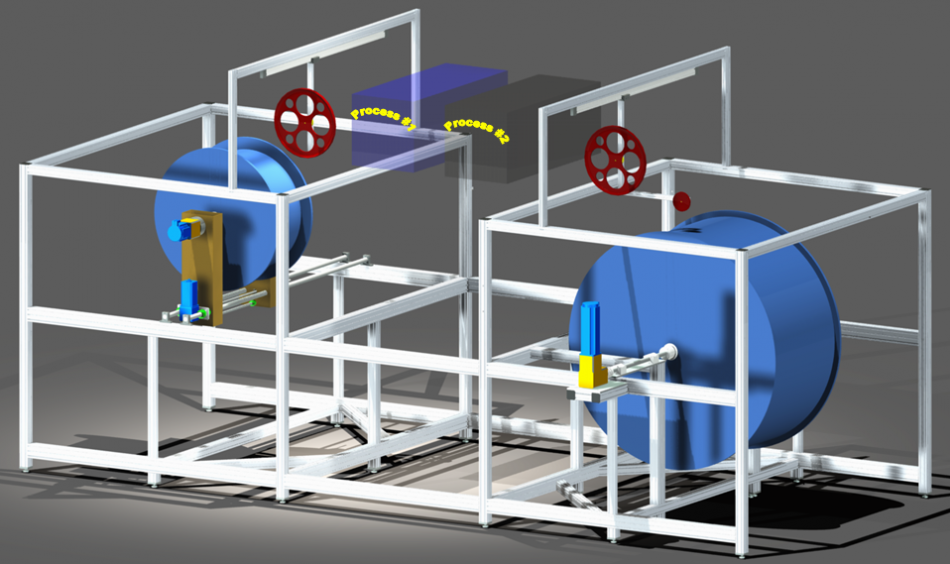
Figure 5: 1000 Series Dual Process Solution Example
MMP-LMHS Positioning
The SC industry requires a technically reliable wire handling solution for common to delicate linear media that completes the SC production steps for both Research and Development (R&D) and Manufacturing as shown in Figure 6. Without the enabling LMHS technology all final application users are extremely hesitant in moving forward with the latest promising SC wire technologies with no confidence in the final product technical reliability. MMP-LMHS solves this national and truly global industrial need for this significant technology development in an automated and versatile fashion and has patent protected the intellectual properly surrounding LMHS innovations.
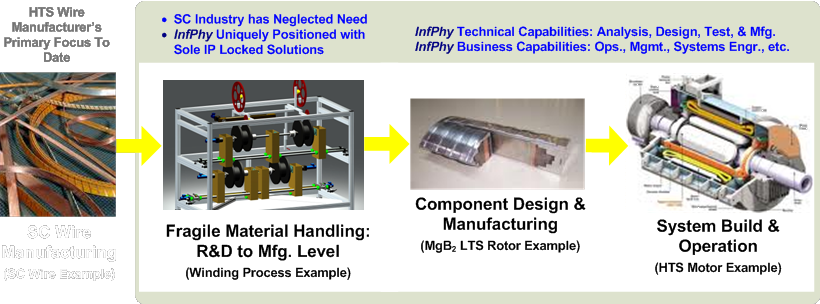
Infinity Physics is in the position to either perform all such MMP-LMHS related tasks either completely within their organization and/or provide a customer with an MMP-LMHS machine and support their needs in any application area whether directly related to MMP-LMHS or not.
Infinity Physics Team
InfPhy personnel actively work in solving application needs for each SC classification area. The team has extensive experience with project research to final system test and implementation in the field of superconductivity and identified the industry need for technical reliability in the 1990s. Throughout a methodical collection of talent for projects more broad in scope than fragile linear media handling or even superconductivity, and all the while following developments in the SC industry, this project developed for more than a decade. Although multiple prototypes developed while performing customer specific requests starting as early as 2004, MMP-LMHS was not fully introduced until August 2010 after the successful test of a full scale prototype for the mass market. Since that time our team has honed their skill set at every technical SC application aspect of SC linear media starting from delicate linear media handling, through to pole development, into machine design, and finally onto complete system integration. Certain members of our staff, considered extremely rare experts in linear media handling and test through to complete machine design, are consequently official technical reviewers for the Department of Energy (DoE) for these areas of expertise. Staffed with international members wielding depth in the fields of physics, mechanical and electrical engineering, controls, procurement, systems engineering, and business process management, the assembled team at Infinity Physics has taken the lead in the automation of linear media handling for the superconductivity industry and, in doing so, intends to lead the SC industry into commercial applications.