
MMP-LMHS Controls
Controller
Overall
Active closed loop controls working in conjunction with appropriate mechanical design techniques are absolutely necessary to attain the delicate linear media handling requirements. This is demonstrated in the following qualitative discussion where winding speed rotational rates are listed as a comparison between a pure mechanical solution versus a combined high fidelity closed loop control and specialized precise mechanical solution for any size wind and associated wind process. A pure mechanical design solution, what almost every large scale winding machine manufacturers use, will often fail the required machine results for any high to even slow rotational speed and occasionally fail at extremely slow rotational speeds. Even in the rare case when extremely slow rotational speeds work for a purely mechanical system, such a slow down decreases winding production line output and hence can cost a company $Ms annually. For an example of a medium rotational speed, the impulse of a dancer pulley alone will fail a coil during many operational states and certainly during every worst case scenario. Worst of all this failure may not be discovered until the coil is in final operation where the timing, financial, and overall project ramifications are severe. Such operational errors will readily cost many $10Ms for subsequent program cancellations. Conversely, this patentable high fidelity closed loop control designed at Infinity Physics, which will exceed typical purchased motor controller specifications for even high end servo motors, allows the ability to wind without fail at lowered speeds but to also fine tune the control with time and to that end increase the safe operational speed and/or delicate wind performance parameters for any wind type. This continual increase in speed alone for the overall machine, as naturally developed by Infinity Physics for any wind size and type as well as for a particular wind range focus, increases winding production output and user sales. Even for the times when a mechanical solution can work, a purely mechanical solution is locked in time and fundamentally can never achieve such optimization and hence better production output goals. Infinity Physics will continually extend the capability of their closed loop controllers through their own research as well as when working with customers. Such controllers are specialized towards the LMHS need which is mostly velocity control driven whereas most controllers are position control driven. Therefore even high end commercial off the shelf (COTS) motion control motors and drives cannot be set to precisely run LMHS without extreme modification. The beauty with the LMHS required form of control is that machine control expansion and optimization upgrades, the heart of this system expansion since the patent pending mechanical designs not shown are fixed at their optimum point, are readily shipped to customers for simple installation similar to any new software installation upgrade. The upgrade effort involved is merely shipping media or an email attachment and then simply installing on the operator’s computer.
Control and Optimization Advancements
Control types included are classical PID, modern state space based controls, and even non-linear control methods. Specialized optimization codes for control advancement range from gradient based optimizers to statistical based optimization where the team has experience from Genetic Algorithms to Neural Networks for forming Neuro-Fuzzy controls. The currently developing Neural-Fuzzy network controller will even allow the control system itself to automatically optimize the operational values for higher performance simply set per the user’s desired output preferences. High end controls and optimization codes, when used properly, can greatly advance both simple to complex systems as previously demonstrated by this team. For the foreseeable future the control design team will continue to hone the ability of LMHS both for more delicate wire and tape requirements as well as increased winding speed by optimizing controls for all LMHS machine series. Any regular control advancement and optimization benefits all customers as they share in a common base controller platform.
MMP-LMHS Control Specifics
Any LMHS active control system at minimum follows a hierarchic, two level control methodology comprising of a top level supervisory controller above subdivided medium level torque and speed controllers. Low level gate switching controls are typically provided by the motor driver. The supervisory controller sequentially controls top level signals. Hence moving the system from state to state generates reference values for the torque and speed controllers. When necessary a complex control scheme introduces a Heath Map capability which performs prognostics from associated diagnostic state based input. The torque and speed controller operates through the use of high fidelity sensors and appropriate hardware and digital signal processing. The torque and speed based controls act to operate the system as fast as possible within requirement limits for a winding condition, protect the system from extreme winding issues, and protect the system during a fault or emergency condition.
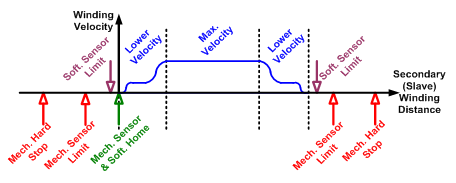
Specifically, the entire control scheme revolves around all direct linear media sense inputs. A top level description of the basic control methodology follows whereas the low level and high fidelity control specifics and supplemental mechanical design elements for fine tuning control support are removed from this discussion. Given these primary sense inputs, the master motoring axis is the follower axis on the former which commonly follows the basic trajectory per layer as indicated in the figure above. The former then provides a constant angular velocity to track the follower and hence guide the wire and tape into the proper former position whether the winding is set to a follower lead, lag, or direct lay up position. The spool acts as an extremely sensitive tensioner in that it controls the linear media tension through a very precise change in rpm programming. Due to knowledge of the former’s command position, the spool and follower both receive a feed forward command in advance of actual machine movement to supplement the feed back commands. In the extreme case, the spool, former, and follower motor controls, gearboxes, and motors are high fidelity units which, supplemented by various LMHS advancements, provide a fast adjustment to any mechanical impulse sensed with no mechanical issues such as spring back, backlash, or a dead zone. Such motor torque responses for large rotational inertia loads as in the former and spool cases can be severe, but are possible through a slowed rotational motion, excellent sense, and motor response. The 10 and 100 Series systems are additionally served by the fact that the maximum spool angular inertial load is less than the maximum former angular inertial load and to that end the spool control can more readily adapt to changing requirements. As an option, the axis brake incorporated into the control scheme allows a potential controlled course speed decrease of the former for a finer controlled decrease of the spool by removing the higher torque requirement and thus also helps mitigate the worst case axial maximum tension scenario outside of a pure emergency stop. Such controls provide the ability to achieve maximum efficiency for the full spectrum of winding velocities witnessed for the plant chosen.
GUI Basics
All 10, 100, and 1000 Series machines including all options are controlled from a single Graphical User Interface (GUI) as depicted in the figures below. This GUI representation has been operating multiple Infinity Physics prototypes to industrial level delicate media handling process machines since 2004. The GUI provides a simplistic interface to control and monitor a fully automated, complex machine. The GUI will also advance with time per customer valued feedback needs.
This GUI provides system manual or automatic wind status and control as well as post processing data output. The GUI is set into three primary areas being winding output on the top and in the center, winding operational state options to run the winding in the lower left, and winding settings to prepare the winding pre and post wind processing in the lower right. The GUI is designed to be used by an R&D developer creating a new R&D wind process step by allowing infinite optional variants to save for a manufacturing line operational user by loading a routine parameter set for a particular wind process and hence maintaining repeatable QC from one winding process to the next including all saved and post processed sensor data. A helpful R&D developmental feature is the recommended operational limit values calculator for a new winding run. The GUI format represented is focused on an R&D developer setup whereas the manufacturing user interface, also part of this exact same GUI interface, experiences the exact same top level feedback but an extremely limited input set of options and lower level feedback monitors versus the developer setup. A helpful R&D developmental feature is the recommended operational limit values calculator for a new winding run.
- Interface
- Simplistic
- Readily suited for R&D developer to manufacturing line user
- Infinite varieties of options possible
- Monitors complete status during wind and warns of issues
- Familiarity: Same GUI across entire LMHS family
- Controls and Data Management
- Fully automated winding system
- Manual wind options available
- Versatile
- R&D wind developer establishes and locks wind parameters
- Manufacturing line user runs QC locked parameters
- Infinite number of saved parameter settings to lock
- Closed loop linear and non-linear controls
- Multiple means of setting desired wind values
- Wind data saving and storage possibilities
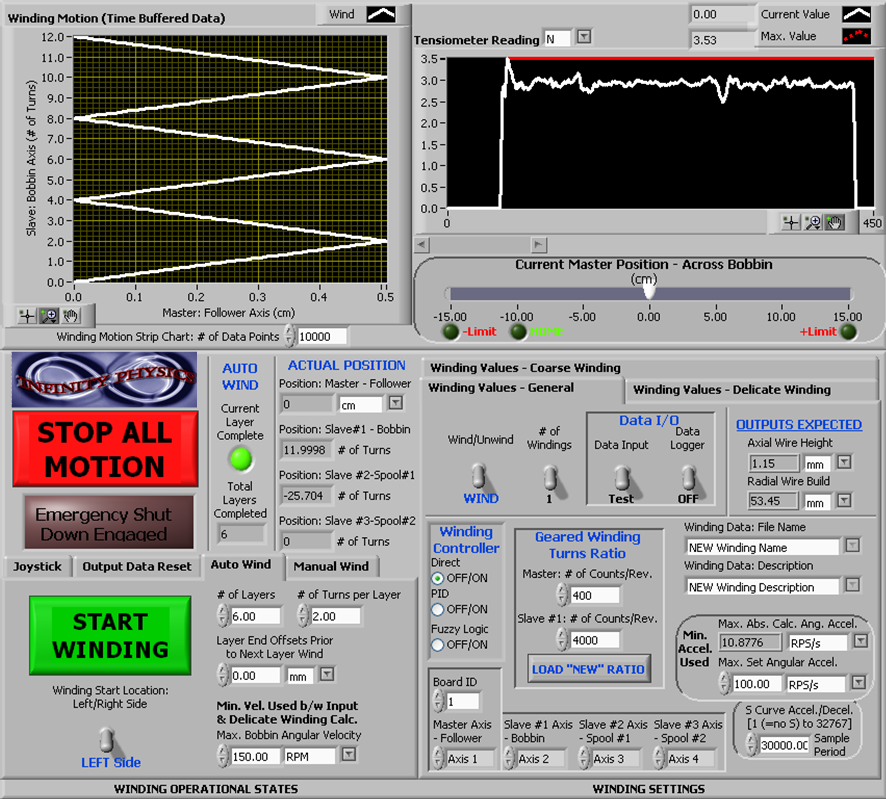
MMP-LMHS GUI: Automated Wind Operation
The automatic wind operational example shown in the figure above, here only representing a piece of the entire operation, was performed for a customer for a medium and small sized power inductor set need for a U.S. Department of Defense (DoD) project on an earlier LMHS setup back in 2007. This example is chosen not for large wind on former rotational mass, diameter, or axial length purposes but instead good axial tension control performance output for a high speed process even with a geometrically irregular wind on former surface. Most of these products required a very tight multi-layered packing factor wind for a 28AWG HPN insulated wire coming from a ~12lbs. spool and winding onto a ~10lbs. former at 150rpm and set to maintain 3N average axial tension with a maximum 0.75N axial tension tolerance which defined the start up overshoot maximum point. After the startup overshoot, the two mid operational steps in geometry and controller recovery is witnessed in the top left plot of the figure. Unfortunately, the final products cannot be presented here due to customer limitations.
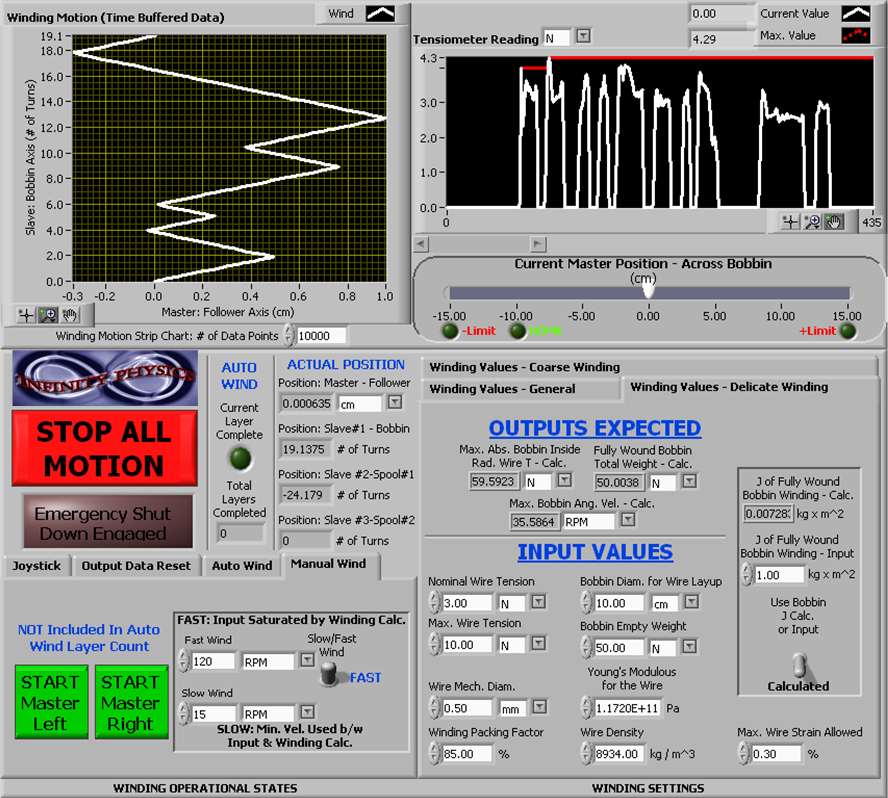
MMP-LMHS GUI: Manual Wind Operation
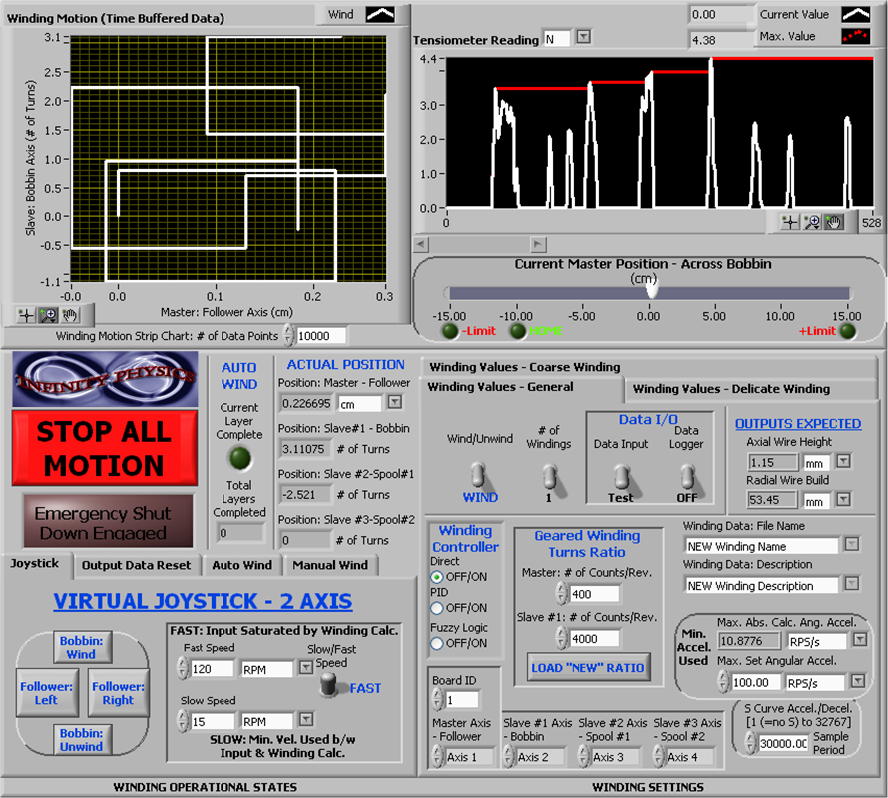
MMP-LMHS GUI: Joystick Operation