
MMP-LMHS Technology – Introducing LMHS
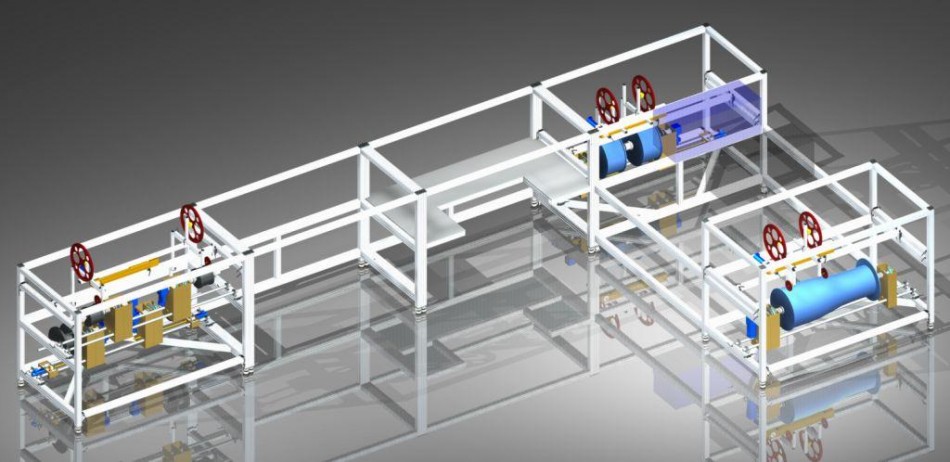
Figure 1: LMHS System
Energy → Superconductivity → Technical Reliability → MMP-LMHS
Technical Reliability Limitations of Past Linear Media Handling Solutions
Conventional winding machines have a long history and sufficed for the majority of the 20th century. Most winding machines offered today require continual manual intervention down to a human interface foot pedal for detail oriented work. Even more constraining, current winding machines rely upon pure mechanical solutions for difficult winding problems. These winding machines are limited to extremely slow manual throughput and no final system quality control (QC) or assurance (QA) which often means a failed winding immediately or via premature operational fatigue. Technical reliability is lost when the SC linear media experiences a handling stress. One actually hopes this stress point damages the linear media to a noticeable degree immediately. Else if the final coil is placed into service then the combined severe mechanical, thermal, magnetic, and electrical cyclic stresses which are unique to an SC coil may fatigue the final coil prematurely and therefore fail the entire machine and hence operational system.
In summary, the products of these tedious methods are prone to inconsistencies that have resulted in low yields and many documented failures.
Significance of Technical Reliability
The Infinity Physics team is quite familiar with many commercial, government, and military systems and their associated needs due to decades of past work directly supporting their technical development. Focusing on the SC linear media industry due to their high requirements yet no proper solution to date, Infinity Physics has involvement with industry players from LTS and HTS wire and tape manufacturers to the final component and device users. Poor performance output as accomplished with winding superconductors using conventional winding machines will not be tolerated in industry. A failed winding, which is unfortunately common per today’s standards and practices, can readily cost on the low end from $10Ks and on the high end many $10Ms to $100Ms when in test. This turns into an incalculable figure for a failed military mission when in final operation. Infinity Physics personnel identified this predicament in the 1990s. It is just recently being recognized more globally by the SC wire and tape manufacturers, SC application end users, and U.S. government entities such as DoE which has historically led this field.
Realizing the significance of the problem, Infinity Physics developed a solution that provides SC wire and tape technical reliability.
MMP-LMHS
To introduce technical reliability into the development of SC applications, Infinity Physics developed a Multipurpose Modular Platform – Linear Media Handling System (MMP-LMHS). Capable of winding a wide range of linear media and not limited to only fragile types, this innovation can serve many industries and is particularly targeted for the SC industry. Addressing the most significant and demonstrated remaining concern for the introduction of SCs in commercial applications, LMHS facilitates an industrial revolution. Robust automation for HTS and LTS based final application needs include MRI magnets, wind turbine applications, fault current limiters, superconducting magnetic energy storage rings (SMES), high magnetic energy coils such as particle accelerator magnets, and of course multiple military applications. LMHS also offers existing and future SC machine final product support needs, whether developed through MMP-LMHS or not, for all maintenance, repairs, and spares from technically reliable spare stocks to fast turnaround new builds. The technology required for automation is a properly designed mechanical solution in conjunction with modern closed loop control techniques. Industries such as superconductivity and fiber optics components require large winds with extremely sensitive linear media care approaching that of filamentary windings but with automation in mind. Classic winding manufacturers, viewing winding as a separate entity and not as part of an automation process line, refuse to move beyond pure mechanical techniques for delicate issues due to the complexities and high risk involved. In many cases there is a belief that the delicate linear handling required today cannot be automated in any respect. For instance, the strain rate of reacted MgB2 SC alone can be 0.1% for a 6” diameter bend which equates to a minimum bend diameter allowable of 22” with no reverse bends when reacted flat. This is seen as too formidable of a challenge to build a reliable product output nevertheless automate yet this is the LMHS starting point.
In summary, although there are other problems to be solved such as in the cryogenic cooling of rotating and linear machinery, the solution for increasing the technical reliability of forming fragile linear media has addressed a significant cause for the lack of proliferation of applied superconductivity.
Technical Approach
Infinity Physics responded to a need and over time developed a robust solution. Not only will LMHS solve the high fidelity winding problem but LMHS also focuses on expanding and automating the entire winding process for extremely delicate to any linear media. As for the delicate linear media case, a combined exceptional mechanical design working in conjunction with a high precision direct closed loop control solution is required for success. As many wound coils today are too flawed for use, LMHS assists with generating quality winds in a controlled fashion that allows not only a proper starting product, but the Mean Time Before Failure (MTBF) will also greatly increase for deployed SC winds. This capability then allows not only initial application winds but a reliable supply chain of replacements including for the first time the ability to design Line Replaceable Units (LRU) of QA supported SC windings which allow SC swapping without taking the larger machine offline. Not only does the unit cost greatly decrease from the increased application efficiency and performance but the means of stocking SC based replacement parts is so extreme a notion that it’s not been considered in the past due to this lack of SC application technical reliability stemming from the SC winding itself.
Technical Capabilities
LMHS fulfills a minimum of the following top-level objective requirements that have been identified through interactions with industrial needs. Objectives below address primarily machine level technological needs and include elements from machine to operator. The overall need is simple and similar for both an R&D as well as a manufacturing perspective. A modern wire and tape handling solution must be capable of the following and all are designed into the MMP-LMHS.
|
|
Safely handle extremely fragile linear media |
|---|---|
|
|
Repeatable handling of extremely fragile media safely |
|
|
Satisfy QC & QA requirements to achieve higher MTBF |
|
|
Perform all tasks to a production level |
|
|
Provide for large range of media, spool, and final former types |
|
|
Provide for anticipated unknown variables and unique requests and provide multiple stock swap options for the same base machine |
|
|
Media handling requires many combined operations |
|
|
Supply chain support including LRU capability |
.
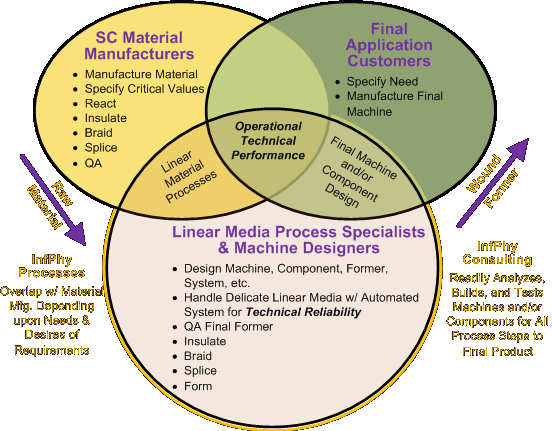
Figure 2: Full Process Solution
As indicated in the bottom region of Figure 2, the innovation achieved by Infinity Physics focuses on far more than creating a wind with inherent technical reliability. LMHS prepares for automation and versatility by designing with the entire system process flow in mind. Therefore LMHS transcends the historic winding machine from a single, isolated process entity into a system providing the foundation of the entire fabrication and assembly line. To consistently control fragile media, such an all encompassing effort provides the best path to achieve physical implementation of linear media handling. LMHS is then used for the initial prototype phase and design phase through to manufacturing while achieving repeatable levels of QC and QA for the first time ever in this industry. Providing the elements necessary for a production line, the necessary supply chain is then finally able to develop for SC applications where QA based components can logistically support a sortie of deployed SC applications.
To achieve automation of winding, Infinity Physics designed sensitive closed loop feedback controls for high precision electric motors affecting both the pay out of media from the spool and also the controlled deposit of media on the former. Axial and off axis tension in the media is precisely controlled and a report of all forces experienced by the media during the wind is compiled. The result is a wind performed much faster than a manual process and supported by quality assurance data.
The range of potential products will bring demands for versatility of the winding procedure. For versatility, the industry standard of dedicated welded steel and cast iron framework for winding machinery was replaced with a framework of aluminum extrusions. Correctly sized, this framework allows easy transformation and expansion of winding procedures including additional operations before, after, and even amidst the media transport from the spool to the former.
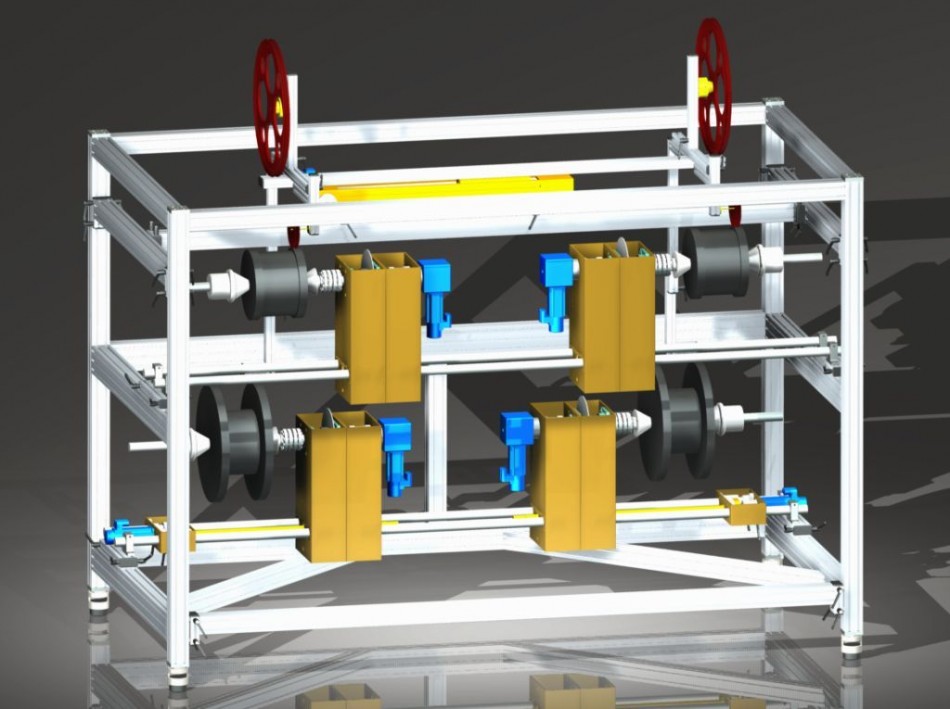
Figure 3: 100 Series Default System
The default configuration chosen for medium sized wind with a maximum diameter in excess of 0.5m diameter and axial lengths of greater than 2m is shown in Figure 3. Shown here, smaller axial lengths accommodate the possibility of dual winds. The default system also features through shaft loading and unloading that can be performed by moving the loads such that they are suspended outside the frame for easy access.
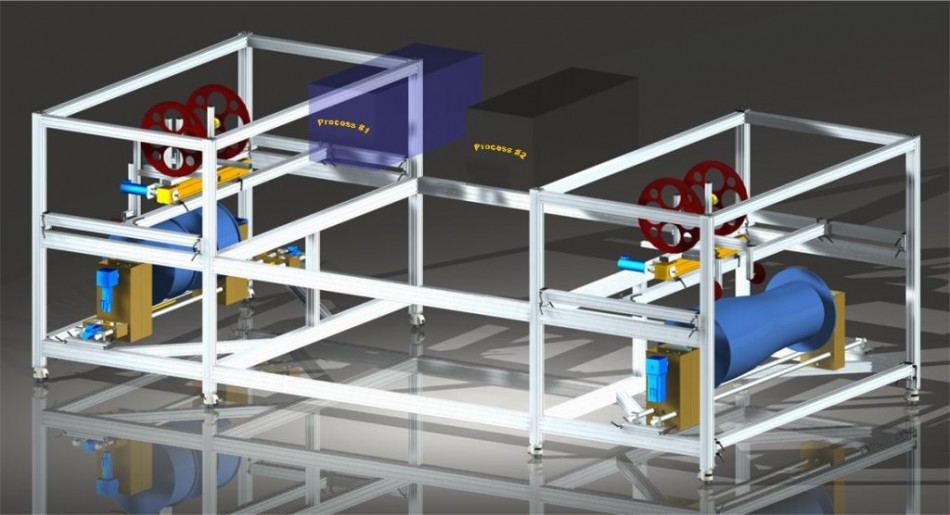
Figure 4: 100 Series Dual Process Solution Example
Figure 4 presents and example configuration where two separate processes of a larger nature are readily provided for a dual wind onto a curved former shape with a simple MMP system and associated control system logic expansion. Such versatility turns an isolated winding process into a complete system solution for the final product coil involving multiple coil processes far beyond winding alone. The aluminum extrusion platform also accommodates customization with established collections of attachments from guards to sensors.
The MMP-LMHS is divided into three distinct machine series which overlap to some degree. Series 10 is provides a small linear media handling solution down to the size of component resistors on a printed circuit board. Series 100 is a medium to large linear media handling solution for items such as motor/generator machines and transformers. Series 1000 is a large to very large linear media handling solution for items such as motor/generator machines, MRI’s, and large accelerator magnets. Due to the inherent versatility each machine line not only benefits from readily swappable stock options but is readily customizable for any solution. This well-thought system approach intends to revolutionize the winding industry to support a revolution in the conversion of electrical energy.
MMP-LMHS Positioning
The SC industry requires a technically reliable wire and tape handling solution for common to delicate linear media that completes the SC production steps for both Research and Development (R&D) and Manufacturing as shown in Figure 6. Without the enabling LMHS technology all final application users are extremely hesitant in moving forward with the latest promising SC linear technologies with no confidence in the final product technical reliability. MMP-LMHS solves this national and truly global industrial need for this significant technology development in an automated and versatile fashion and has patent protected the intellectual properly surrounding LMHS innovations.
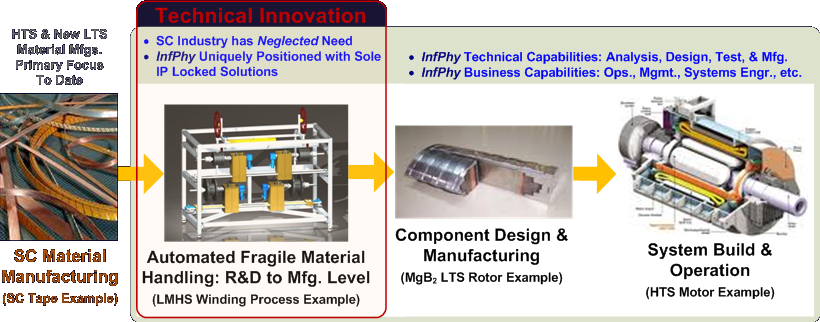
Infinity Physics is in the position to either perform all such MMP-LMHS related tasks either completely within their organization and/or provide a customer with an MMP-LMHS machine and support their needs in any application area whether directly related to MMP-LMHS or not.
Infinity Physics Team
Infinity Physics personnel actively work in solving application needs for each SC classification area. The team has extensive experience with project research to final system test and implementation in the field of superconductivity and identified the industry need for technical reliability in the 1990s. Throughout a methodical collection of talent for projects more broad in scope than fragile linear media handling or even superconductivity, and all the while following developments in the SC industry, this project developed for more than a decade. Although multiple prototypes developed while performing customer specific requests starting as early as 2004, MMP-LMHS was not fully introduced until August 2010 after the successful test of a full scale prototype for the mass market. Since that time our team has honed their skill set at every technical SC application aspect of SC linear media starting from delicate linear media handling, through to pole development, into machine design, and finally onto complete system integration. Certain members of our staff, considered extremely rare experts in linear media handling and test through to complete machine design, are consequently official technical reviewers for the Department of Energy (DoE) for these areas of expertise. Staffed with international members wielding depth in the fields of physics, mechanical and electrical engineering, controls, procurement, systems engineering, and business process management, the assembled team at Infinity Physics has taken the lead in the automation of linear media handling for the superconductivity industry and, in doing so, intends to lead the SC industry into commercial applications.