
MMP-LMHS Technology – Superconductors
What Are Superconductors?
Energy → Superconductivity
Superconductors (SC) are materials that have the ability to conduct electricity without loss. These electrical conducting materials do not obey Kirchhoff’s laws of [Voltage = Current x Resistance]. The reason being an SC has no electrical resistance or on a materials level there is no drift velocity effect from the material lattice on the electrons to impede a moving current. A theoretical reason for such perfect conductance comes from electrons or other fermions travel through an SC by distorting the material lattice with what is known as a Cooper pair. The only resistive elements in an SC in the SC state are splices between SCs or connections to the SC. The net effect is still many orders of magnitude less resistance and hence a negligible current drop for an SC over a classical conductor.
The primary difficulty with SCs is that to date they only operate at very low, cryogenic, temperatures. A further known relationship is the higher the power or energy application, the lower the temperature operational requirement. On a microscopic scale this is due to the weak Cooper pairing force where a minimal amount of thermal agitation exceeding the low electron volts (eV) pairing energy will break the Cooper pair. On a macroscopic scale this temperature dependence leads to an SCs falling out of superconducting mode when they leave what is called the corner point bounded by what is known as the SC’s critical temperature, magnetic flux density, and current density as depicted in Figure 1. These interrelated values represent the temperature, magnetic, and current values that an SC must remain within else the SC phase of the material is lost. Therefore the SC must operate below these critical values at all times.
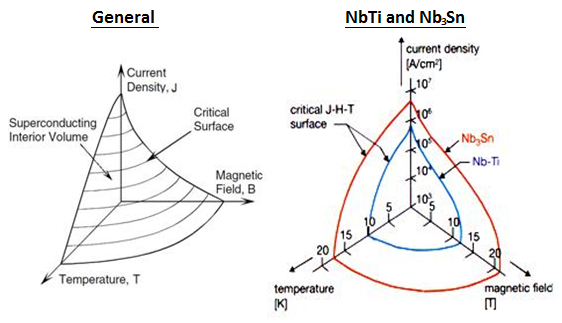
Figure 1: Superconductor Critical Value Corner Points
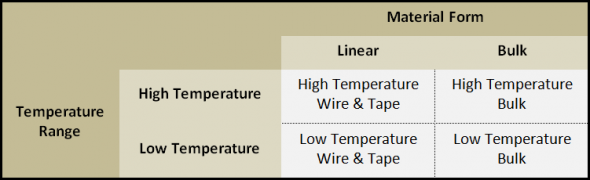
Further discussion of the critical values requires the introduction of superconductor classifications by material form and characteristic temperature. In the application world there are 4 overlapping classifications for SCs as listed in Table 1.
Table 1: Superconducting Material Classifications
Of the three critical values, only SC temperature is externally controlled. Conversely, the magnetic field and current density are both controlled to some degree from the initial SC material fabrication through to operation of each SC type. The current density is controllable for a wire or tape type SC but not a bulk type SC where current vortices surrounding flux pinning centers are an artifact of the material. The magnetic flux density is only controllable when discussing an external magnetic field applied whereas the self magnetic flux density is also an artifact of the current density within the SC and once generated it can only be controlled through surrounding material and geometric choices once leaving the SC.
Another method of SC classification is according to base superconducting phenomena. SCs are either Type I or Type II. For energy and power system applications, Type II SCs are relevant.
Why Superconductors?
When considering a product, SCs bring a higher complexity and initial cost than non-SC conventional solutions that have stood the test of time. So why make the SC leap?
Engineers make a living through the term, ɳ , efficiency. Otherwise, all engineers would be physicists. Engineers across all disciplines struggle to attain increased power efficiency and in particular within a decreased mass and volume, or power density.
Resulting from zero electrical resistance, SCs provide potential for exceedingly high efficiencies and power densities compared to any non-SC conventional option. This high efficiency and/or power density prospect is the primary driver for any SC application. SCs allow the highest amount of controlled macro scale power dense electromagnetic current transfer known to humankind to date. The resistive power loss which turns electrical current into heat is a great concern from small computers to large energy and power systems. In the latter case, power transmission requires a high current density to assist the transfer of electrical inertial energy and preferably low magnetic fields to remove latencies in the form of reactance values but more importantly to remove any additional losses from the motion of flux pinning centers and added induced current loss effects. Certainly the electromagnetic effect involves a combined electrical and magnetic field, but the Type II SC material can be produced to increase or decrease the number and types of flux pinning centers which in turn assists with holding more magnetic flux at a certain location to increase the magnetic field or decrease the flux pinning centers and thereby increasing the current density possible. In the energy systems case of a motor or generator type machine, this machine type is only a dynamic electromechanical transformer with a magnetic link between the mechanical and electrical sides. Such a machine requires a high magnetic field linkage in the air gap.
Why Superconductors Now?
SCs offer the potential for an application revolution in energy systems, the transformation or storage of energy, and power systems, the motion of energy. Focusing on energy systems for rotating machines, these machines can become extremely power dense due to a high rotational velocity or the increased magnetic flux density capabilities an SC provides over conventional wire wound machines or even permanent magnet based machines. A power density increase via a rotational velocity increase is well suited for a medium to small machine size where gyroscopic motion and other velocity related effects are not a concern. A power density increase via a SC machine plant operates fundamentally by increasing the primary to secondary coupled magnetic flux density which for a motor translates to a torque increase and for a generator to an emf increase. In the machines industry alone there has only been incremental advancement for over a century within the plant part of the system. The advent of large scale SC machines would be the first revolution in this industry since its birth in the late 1800s. Minor revolutions did occur while developing our basic machine types in the late 1800s to early 1900s but otherwise this industry has been mostly static from the plant side. In the late 1980s and 1990s another minor revolution occurred on the machine control side due to ancillary developments stemming from semiconductor switching technologies for higher voltage and current combined with computers for low level Pulse Width Modulation (PWM) controllability to medium level vector control.
This can all now change with the first major machine plant advancement in a century. Thanks to the cost and reliability of another ancillary technology in the past decade, cryogenics becoming more robust and affordable even down to low cryogenic temperatures, SCs are finally becoming an application reality. Due to the loss of SC if there is a cryogen loss, then cryogenic equipment is still vital and must advance, yet proper reliability through redundancy techniques of both the cryogen circuit and supporting vacuum jacket can solve most of today’s application issues.
SC materials have cleared the technical performance hurdles when maintained at low temperatures some time back, many costs have finally lowered to marketable levels, and many past ancillary cryogenic concerns are solved. Among SC form classifications presented in Table 1, technical performance of bulk SCs is subject to some remaining challenges however linear type SCs perform very well in the lab and in small quantities have been wound and operated in single custom device operations.
Led by the proven performance of linear type SCs, supported by recent improvements in required cryogenic systems, and motivated by an expanding need for energy, the SC industry is finally ready to embark upon a new technological revolution. Design and support businesses must prepare for the technical application of SCs through to commercial production.