Accept the impossible as an improbable not yet solved.
Consulting Approach
Programmatic Approach
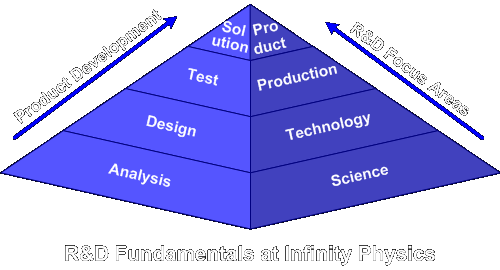
For every new program the team structures an integrated plan that is fully responsive to the requirements and designed to guide towards success. This often necessitates a system approach from feasibility study to final developmental stage and therefore each analytical to physical hardware subcomponent develops as constituent elements which later combine to provide the final system. The figure above provides the top level details of this project plan per the top level tasks required.
Work Methodology
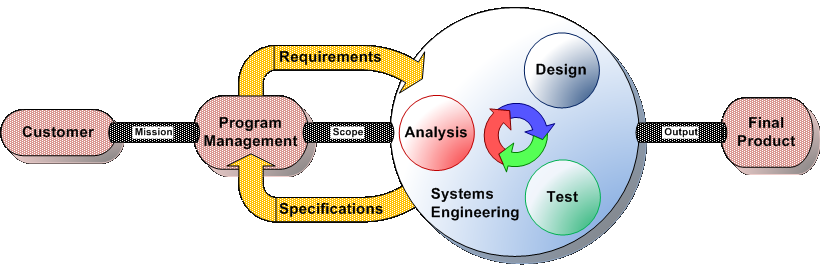
The above figure outlines the overall business structure for all phases of a program. Program management dynamically assumes the customer mission while developing and tracking the scope as the program matures. The team’s framework is a combination of team and matrix based which provides the efficient and effective flexibility to manage the diverse and specialized project goals. Competence in systems engineering and program management assures clear definition of technical business interfaces. A Work Breakdown Structure (WBS) divides the comprehensive scope into manageable elements. Earned Value Management, when applicable, tracks successful progress across operations. Systems engineering conveys and manages all current and future technical elements of a program scope in a structured format. When major subsystem design analyses lead specification development, systems engineering tools integrate into numerous functions such as providing design specifications from customer requirements, supporting verification of these requirements, performing trade studies, design demonstration, and test. Such system analysis reduces both design and test risk.
Risk Mitigation
As with any cutting edge R&D technology, risks must be identified to ensure that they are mitigated. All principal features of any program plan serve to limit risk prior to any hardware development. All analyses are structured to support design and test to facilitate lowered risk. Whenever possible a design develops upon basic and mature technologies existing and in practice today.
Typical Technical Risks Identified
- Creating technology that may work in the “laboratory,” but could prove impractical in the real-world application.
- How can InfPhy comprise adequate scientific, engineering, and technical expertise as well as properly test and validate all aspects of the newly developed technology including operational functionality?
Typical Technical Risks Identified
- Whenever possible system elements are based on existing and operational applications in part or in whole. Real world application of an exact system is validated through the development of fully operational elements to complete system tests to precede subsequent field validation tests and into final system.
- InfPhy’s scientific and technical personnel each enjoy an established legacy of scientific, engineering and technical expertise recognized by the scientific community globally and within numerous U.S. government branches that are an integral part of the National Security of the U.S. This same level of expertise is the key cornerstone of any new technology project. Furthermore, the InfPhy integral testing facility ensures validated performance, reliability, and functionality that meet the same exacting standards as established by U.S. government entities.
Analysis & Test
Analysis
All critical points are analyzed to adequately support the physical hardware plant, control, and optimization studies from the overall system to subsystem build and tests throughout the entire design process. Via systems engineering, analyses supply specifications for each requirement while supporting design verification. The key to a successful program is complete and accurate analysis of all aspects of the system stemming from first principle mathematics. First principle mathematics not only establishes the correct design response characteristics, but also develops a platform for predicting proper response for all future design changes prior to working with physical hardware.
Test
Via systems engineering, tests validate or modify the analyses and associated designs and hence support or modify design specifications accordingly. Tests include component to full system tests.
National Instruments Labview™ software, the premier choice for R&D test and associated manufacturing work, communicates with and controls real world test devices for R&D and manufacturing level testing through real time environment dedicated computer control processing units (CPUs).
National Instruments multifunctional data acquisition (DAQ) hardware is the primary test DAQ and control interface for all component to system level testing sensors although a variety of oscilloscopes and other meters will supplement all tests depending on use and need.
Infinity Physics, LLC is a National Instruments Alliance Partnership Member. Various team members are trained through a long series of courses at the National Instruments site in Austin, TX aimed towards National Instruments Labview™ Professional Architect Certifications. This is the highest developer certification level available.
Technical Tools
The proper choice of software platforms is vital to performing a capable, efficient, enduring, and robust analysis and connection to real hardware. All technical work initiates from experienced based intuition driving an approximated analytical solution based on basic mathematical principles. When applicable, a multiphysics numerical system simulation model captures the global integrated functional power flow and response effects for the entire system. Finite element analysis (FEA) provides detailed multiphysics results on a more geometrically form and fit localized level. Both the multiphysics numerical system simulation and FEA capture particular points of interest within the system response.
PTC Windchill®manages all corporate technical data from a functional standpoint. Utility includes Product Data Management (PDM), Requirements Management, and Manufacturing Process Management to support Systems Engineering, Configuration Management (CM), and product Total Lifecycle Management (TLM).
PTC Creo®, the most capable computer aided drafting (CAD) package available, is the CAD software chosen. CAD provides mechanical engineering design support, FEA mechanical input through de-featured models, and virtual reality simulation 3-D mechanical models. Capabilities including lifecycle management and integration with corporate functions thru PTC Windchill®
The PTC Mathcad® software platform is often the choice to develop a quick multiphysics analytical solution system simulation though the use of non-conservative mathematics. Working in conjunction with PTC Creo®, PTC Mathcad® develops primary multiphysics numerical solution system simulation though the use of non-conservative mathematics.
The Mathworks Matlab® and Simulink® software platforms develop the primary multiphysics numerical solution system simulation though the use of conservative and non-conservative mathematical elements. The conservation of power and energy maintains the conservative to non-conservative mathematical link. Finally, a numerical virtual reality graphical output model based on first principal mathematics is often chosen to present final results when applicable.
The Ansys® multiphysics computational analysis software package develops the multiphysics FEA and associated virtual reality output of results. Although cached FEA software packages are available, the flexibility of various physics Ansys® packages to Workbench® multiphysics connectivity allows extreme versatility in any math environment possible through the best FEA package available to date. Additionally Ansys® can couple to Mathworks Matlab® if desired for a higher fidelity system level simulation response.
Back